
The NTA has given me a response to the letter I wrote to their CEO about public transport issues in our area. In November, I demanded action from the CEOs of the public transport companies, not just as your representative, but as an almost daily bus and Luas user myself. The National Transport Authority has given me answers, some positive and some negative. As always, I will keep fighting for you on this as your only public representative that regularly uses public transport.
Behind all of their responses is an undercurrent that this government have simply not kept up the investment needed to improve our public transport services. This was reported on in the media in January, see below. It’s one thing for our TDs to say they’re serious about public transport but they are the ones that approve the budgets that limit the funding needed.
While the public transport providers need increased government funding to improve our services, they still need to be held to account for day-to-day issues within their control. I brought up six main issues with them:
- Reliability and punctuality
The basics of running buses or trams is that they will actually show up and that they will show up on time. Driver shortages have meant that Dublin Bus and GoAhead have prioritised other routes meaning that sometimes the buses in our area don’t even show up. The L26, 44, 47, 114, 118, S8 and 14 are some of the worst services in Dublin. Whether you take them to where you’re going or to get down to the Luas.
The NTA denied that there is a policy of prioritising city centre-bound services ahead of local services whenever there are driver shortages. They said that they will “continue to monitor this with each transport operator” and have requested “that transport operators prioritise the continued operation of lower-frequency services (including local routes), where resource limitations exist”.
On the face of it, this is good to hear, but I’m still skeptical. I still believe our bus routes are being deprioritised when the high frequency routes need more drivers. Please let me know if you notice any local routes being cancelled.
- Frequency
People feel that it’s risky to rely on a bus that only comes every hour and even when it does come, it could be full. Most urgently, this needs to be addressed for the 44, 47, 114, L26 and S8. I again asked for the 44B to run on weekend as well.
The NTA has said that they are able to analyse Leap Card data to look at over-capacity. They have added capacity on other routes (Route 39A, Route 15 and Route E1) and will be reviewing other routes in early 2026. Talking about the Route 44b, they said:
“Route 44b will be replaced by route L33, running over the same alignment between Dundrum and Glencullen. It would have a similar frequency, though detailed timetables will be set nearer the date of operation which is currently planned for 2027. We will take account if the latest demand information and will consider providing a weekend service as part of that”.
So no real commitment from the NTA to increase our bus frequencies. The elephant in the room here is the growth in housing in our area in the recent past and in the near future. The government are heavily relying on our area in order to solve the national housing crisis, but when we ask for more frequent buses, we’re repeatedly ignored.
- Routing changes
The BusConnects Plan first consulted with people here in 2018. Since then, there’s been a lot of change, at a rate faster than almost anywhere else, with new schools, housing and roads built. I asked them to take this into account, especially the need for buses to connect secondary school children to our area’s largest secondary school, Stepaside Educate Together Secondary School.
I got a relatively positive response here from the NTA: “Given the growth in the area, we are considering extending more service south of Belarmine than originally planned. As always, enhancements are subject to funding and operational readiness.” I hope these increased frequencies are coming soon, and not on the long finger for years. And they need to move from “are considering” to putting extra buses on the road urgently.
Not to mention that we still need a 7 day a week Dublin Mountains bus between Dundrum Luas, Glencullen and other parts of our upland areas.
- Physical infrastructure
We need more bus shelters. We live in a very exposed part of the county, where the weather can be severe. We’ve had some signs that bus shelters might be coming but we’ve seen a huge slowdown in their delivery. I asked Roderic O’Gorman TD to put in a question to the Minister for Transport on how many bus shelters are being built in Dublin. 3 new bus shelters in 2025, down from 37 in 2024 and 30 in 2023. The Taoiseach thinks it’s beneath him to take questions on this.
The NTA acknowledged that the responsibility for new bus stops is moving to the Council, with a €500,000 allocation for DLR to install bus stops in 2026. The NTA will connect the Council to their contractor to streamline this process. The Council can decide where to use this budget and put new bus stops in consultation with the NTA. They “expect to see the commencement of a steady supply of new shelters to the new designs later this year”. But unfortunately we were told something similar last year.
On Real Time Passenger Information (RTPI), the display that shows you when the bus is due to come: The NTA says it is expensive to install (because of costs) and not feasible at all sites (because of works needed to establish an independent power supply). However, they say that the App contains the exact information that is available on the RTPI screens.
I will keep pushing both the Council and the NTA to install more, good-quality bus stops in our area.
- Bus layovers
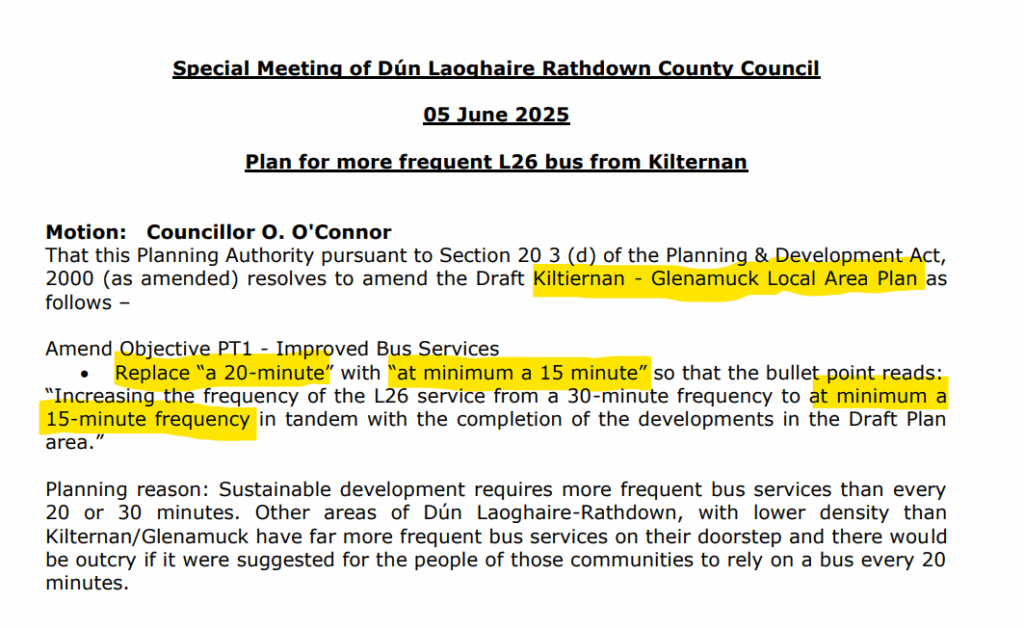
The plan to provide a bus layover facility off the Glenamuck Road in Kilternan has seemingly fallen off the radar. It needs to be a priority, as a key enabler to more frequent buses for the area.
The NTA’s response was: “Recognising the rate of growth in the area, the NTA has been engaging with DLRCC to secure additional bus terminal space as part of the Glenamuck development. Unfortunately, this was not directly allowed for in the original masterplan and grant of permission. However, with the help of Council staff, we have been working to ‘retrofit’ a facility. The original plans could not be made to work, given the way in which land had already been allocated for other uses, but an alternative location has been identified. We are also seeking to modernise the existing terminus in the village centre, so that it may continue to be used.”
I will keep you updated as I get more information about what “modernising” the terminus in Kilternan village means.
- Luas capacity
The Luas is at full capacity. When we add thousands of homes that are currently under construction, this problem is only going to get worse. To help with this, we need a turnback facility near Charlemont. What’s the turnback? So first, the important thing to know is that the bottleneck for the Luas is when it runs on-street in the city centre from Charlemount to Broadstone. They can’t add more trams between these sections because of this. But they could add more trams that at least get you to Charlemount. Because of how busy the line is, they would need these extra trams to turn back on an extra length of track.
The NTA said: “We have no current plans for increasing capacity on the Green Line using the turnback facility near Charlemont. However, we will take your comments into account in planning any future enhancements on the Green Line.”
This is very disappointing and a setback if you rely on the Luas to get to town at peak times, especially as it gets more and more packed. I will continue the fight on this and other ways that we can improve capacity here.

If you have any ideas on how we can make public transport in the area better, I would love to hear from you – email me at ooconnor@cllr.dlrcoco.ie.
All 6 issues I raised and the full response from the NTA on each of them:
1) The basics: Reliability and Punctuality
OO’C: The 47, 44 and 118 are 3 of the most complained about Dublin Bus services. The S8 and 114 are two of the worst on Go Ahead’s list. The L26, L27, 14 and 74 are slightly better but not by much. I am well aware that when there are driver shortages, the routes that run to the city centre are prioritised. As you would well know, the main way people in Glencullen-Sandyford get to the city centre is by Luas, but thousands rely on local bus services to get them to their nearest Luas stop. Please review this policy and do not abandon our local bus services when there are driver shortages.
NTA reply: There is no policy of prioritising city centre-bound services ahead of local services. Given the acute impact of service cancellations on passengers who rely on low frequency services (particularly where no other options exist), the NTA has requested that transport operators prioritise the continued operation of lower-frequency services (including local routes), where resource limitations exist. We will continue to monitor this with each transport operator.
2) Frequency of Buses
OO’C: Especially at peak times, there is a serious deficiency in bus services for commuters in Glencullen-Sandyford. Lack of frequency also reduces confidence as people feel it’s a risk to rely on a bus that comes every 30 mins because if it doesn’t show up, or is full then you’ll be 30 mins+ late for work. I could go through every bus, but the ones that most urgently need more frequency at peak times are the 44, 47, 114, L26, S8. The 44B needs to be running on weekends. How you can just leave people in Glencullen with a Monday-Friday bus is beyond me.
NTA reply: In recent months, the NTA have developed a tool which utilises the available ticketing and Leap card data to identify and prioritise bus routes which are operating above normal capacity. Using that tool, we have been able to develop a prioritised listing of bus routes with over-capacity issues, which we are seeking to address, in so far as is possible, within the driver, vehicle and funding constraints that we operate. The three routes with the greatest capacity issues were identified on the tool as Route 39A, Route 15 and Route E1. We added capacity to Route 39A earlier in October and subsequently additional capacity to Routes 15 and the E1 on 3rd November. Further routes are being reviewed to determine where to prioritise additional trips in future rounds of service enhancements, currently planned for early 2026.
Route 44b will be replaced by route L33, running over the same alignment between Dundrum and Glencullen. It would have a similar frequency, though detailed timetables will be set nearer the date of operation which is currently planned for 2027. We will take account if the latest demand information and will consider providing a weekend service as part of that. All dates and service increases are subject to funding and operational readiness.
3) Route Changes
OO’C: The first consultation for the bus connects plan was in 2018 and the plan finalised in 2020. Given our area has undergone so many changes, at a faster rate than other areas, and so much has changed since those plans (new schools and housing built, new road layouts), I’m asking you to review the bus routes in light of that. This is especially relevant for the Kilternan area, where there is no secondary school, so students rely on bus connections even more than other schools.
NTA reply: Prior to the implementation of any phase of Network Redesign, the NTA carries out a detailed review of the proposals to ensure that the revised network will cater for the projected demand in that area. Given the growth in the area, we are considering extending more service south of Belarmine than originally planned. As always, enhancements are subject to funding and operational readiness.
4) Physical Infrastructure
OO’C: The lack of bus shelters, seating at stops and real time displays is stark in Glencullen-Sandyford, especially when compared to other areas. We are living on the side of a mountain, for your information.
I have previously sent a list of bus shelter requests and some were said to be under consideration, but none have even gone through the planning process in recent times. The bus shelter for Kilgobbin Road was applied for but the NTA withdrew the planning application, which I find hard to understand. The 14 bus stop on Ballinteer Road got planning permission for a bus shelter two years ago. No sign of it happening. Please prioritise this.
NTA reply: We note that each local authority across the State, including Dun Laoghaire Rathdown County Council, has received an allocation of €500,000 in 2025 under the Bus Stop Enhancement Programme (BSEP). The funding provided under this programme is intended to enable each local authority, in collaboration with the NTA, to enhance bus stop facilities at bus stopping locations within its administrative area, including the provision of bus shelters where appropriate.
To further assist local authorities and make the process more streamlined, the NTA will, through a central supply contract, provide any required bus shelters to the local authority and will also make available the NTA’s bus shelter contractor to the Council to undertake their installation (following the Council’s preparatory works). In addition, the NTA will also arrange for its contractor to maintain the bus shelters subsequently.
The determination of where to install bus shelters in a county or city will now be largely undertaken by the relevant local authority under the BSEP, with the final programme of installations to be agreed with the NTA. The NTA continues to engage further with the Executive of each local authority on an ongoing basis to agree the programme of such works for the remainder of 2025 and going forward into 2026.
In that regard I note that the NTA has retendered its bus shelter contact which expired at the end of March 2025. The previous contract had been in place since 01 January 2017. As of 01 April 2025, the NTA has entered into a new bus shelter contract with a new service provider – Bauer Media Outdoor (formerly Clear Channel Ireland) – following a procurement process which extended into early 2025. The incumbent bus shelter contractor, JCDecaux Ireland, was unsuccessful in the tender process.
Bauer Media Outdoor has assumed responsibility for the supply, installation, management, and maintenance of the NTA’s bus shelter estate for up to 8 years. Shelters will be delivered for installation following a mobilisation period under this new contract. That mobilisation period allows the new contractor to complete a design, including a structural design, for the new bus shelters and to activate the supply chain to manufacture the new shelters. That mobilisation process is well advanced, and we expect to see the commencement of a steady supply of new shelters to the new designs later this year.
We will bring this request to the attention of the relevant Council personnel who are preparing the Council’s prioritised programme, in respect of the BSEP. Following a determination by the Council we will also bring it to the attention of our bus shelter contractor who has been appointed under the new contract to establish if a workable solution can be arrived at, which will assess the feasibility of providing a bus shelter at the stop, enabling its inclusion on a provisional installation list if considered feasible. It is worth noting that not all locations are suitable for the installation of bus shelters due to underground services, width issues, sight line issues, access issues, or similar other items such as the negative impact on affected parties / adjacent premises. Each location is required to be technically assessed against current technical requirements, road safety matters, accessibility standards, third party planning matters, available space in addition to the design details.
Real Time Passenger Information (RTPI). At present there are over 12,000 bus stops in Ireland serving a variety of bus services including local, urban, and regional bus services across a variety of operators. Because of the costs associated with the provision of on-street RTPI signage, it is not feasible to provide Real Time Passenger Information (RTPI) signs at all bus stop locations.
One of the main reasons for these costs is the need for an independent power supply for RTPI signs. These signs require an electrical supply in order to operate and there is a prohibition under statutory regulation, derived from European legislation, that prevents the NTA from taking an electrical connection from an existing public lighting power supply, even where convenient and adjacent. Instead, a separate independent electrical connection is required from ESB Networks, which can often necessitate extensive trenching, road crossings, and major reinstatement work, all contributing to significant costs. As a result of these costs, and to ensure value for money, it is intended to only provide RTPI as an integrated sign within a new bus shelter or, depending on suitability, within an existing bus shelter that already has an independent power supply and has been designed to accommodate an integrated RTPI sign. In that way, a cost-effective single integrated power supply can be provided, powering both the bus shelter lighting and the RTPI sign.
Notwithstanding the constraints and limitations outlined above, it is worth noting that all of the information available on such RTPI Displays is also available through the NTA’s app for RTPI. The “TFI Real Time Ireland App” and the RTPI The App is available free on Apple App store and the Google Play store and combines all real time information services from Bus Éireann, Dublin Bus, Go-Ahead Ireland, Iarnród Éireann and Luas. All bus stops have a number at the top of the bus pole indicating the particular bus stop number. Simply inserting that number into the App provides the RTPI information on bus arrival times at that stop. The App and the RTPI units are supported by the same back of house data feed. There is no difference between the information contained on RTPI units and App. We would encourage travelling passengers to download and trial the app to get familiar with all the real time information available to passengers at each bus stop. Additionally, we also note that when passengers scan the QR code contained on the timetable panel it should bring them to data relating to that particular stop number within the TFI Live app. Finally, if necessary, Dublin Bus can provide printed timetables for customers use at their offices in O’Connell Street or if requested via their Customer Services team.
5) Bus Layovers
OO’C: I have heard from DLR and landowners that the NTA have been disengaged from the plan to provide a bus layover facility off Glenamuck Road in Kilternan. This project should be a high priority given its importance in supporting higher frequency buses in Kilternan. Please make this a priority.
NTA reply: Recognising the rate of growth in the area, the NTA has been engaging with DLRCC to secure additional bus terminal space as part of the Glenamuck development. Unfortunately, this was not directly allowed for in the original masterplan and grant of permission. However, with the help of Council staff, we have been working to ‘retrofit’ a facility. The original plans could not be made to work, given the way in which land had already been allocated for other uses, but an alternative location has been identified. We are also seeking to modernise the existing terminus in the village centre, so that it may continue to be used.
6) Luas capacity.
OO’C: The Luas is at capacity before the 2,000 homes under construction are even finished, and that’s not counting Cherrywood. Please start increasing the capacity of the Luas using the turnback facility near Charlemont. If the Minister for Transport won’t fund it because has other priorities, so be it. Btw I would encourage the NTA not to be the ones holding back the project.
Overall, the people in this area are losing patience with the public transport system and also the feeling that we are being ignored. I know it doesn’t help that our TDs are silent on our public transport issues, but I am please asking you to take your public duty seriously and address these issues. As always, I am available to meet with representatives of the NTA before things get worse and I will arrange for all local Glencullen-Sandyford councillors to be invited if you are open to engaging more collaboratively with us.
NTA reply: We have no current plans for increasing capacity on the Green Line using the turnback facility near Charlemont. However, we will take your comments into account in planning any future enhancements on the Green Line.